
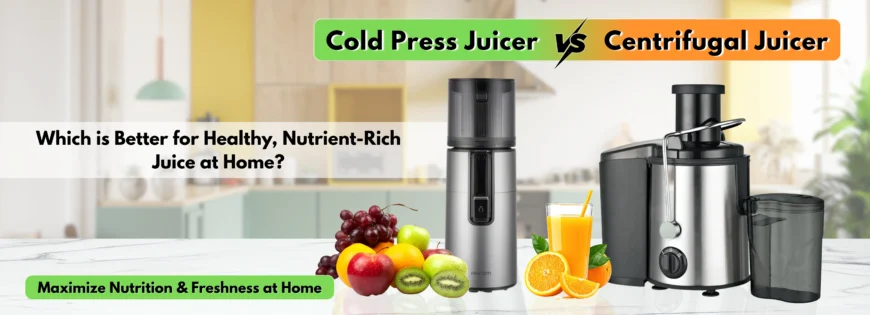
Cold Press Juicer vs Centrifugal Juicer: Which Is Better for Healthy Juice at Home?
In today’s fast-paced professional life, health often becomes a secondary priority. Long work hours, screen fatigue, irregular meals, and stress make it difficult to maintain optimal nutrition. That’s why more health-conscious professionals are turning to fresh homemade juice as a simple yet powerful way to support energy, immunity, and overall well-being.
For Indian households specifically, the difference matters even more. We regularly juice amla, raw turmeric, orange, beetroot, spinach, and methi – ingredients that a centrifugal juicer either struggles with or extracts poorly. A cold press juicer handles all of these effortlessly while preserving every nutritional compound that makes Indian produce so valuable.
But when it comes to choosing the right juicer for home, one question dominates the conversation:
Cold press juicer vs centrifugal juicer — which is better for healthy juice at home?
While both appliances extract juice, the technology, nutritional impact, and long-term value are vastly different. This guide breaks down the differences clearly, helping you make an informed choice that aligns with your health goals, time constraints, and lifestyle.
Why Juicing Matters for Busy Professionals
Fresh juice is one of the easiest ways to consume essential vitamins, minerals, antioxidants, and enzymes—especially when cooking balanced meals daily isn’t always possible.
The quality of that nutrition, however, depends totally on how the juice is extracted. Two glasses can look identical but deliver completely different nutritional value depending on the juicer used.
For professionals juggling meetings, deadlines, and personal commitments, juicing offers:
- Quick nutrient absorption
- Easy digestion
- A convenient alternative to processed snacks
- Support for immunity, gut health, and sustained energy
However, the quality of juice depends entirely on the juicer you use.
Understanding the Two Juicer Types
What Is a Centrifugal Juicer?
A centrifugal juicer uses high-speed spinning blades to shred fruits and vegetables. The juice is then separated from pulp using centrifugal force.
- Operates at very high speeds (6,000–14,000 RPM)
- Commonly found in entry-level or budget juicers
- Fast juice extraction
What Is a Cold Press Juicer?
A cold press juicer (also known as a slow juicer or masticating juicer) uses a slow-rotating auger to gently crush and press produce.
- Operates at low speeds (40–80 RPM)
- Minimal heat and oxidation
- Designed to preserve nutrients
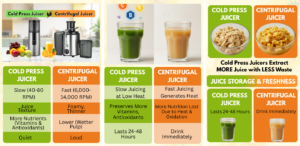
Cold Press Juicer vs Centrifugal Juicer: Quick Comparison Table
| Feature | Cold Press Juicer (Slow Juicer) | Centrifugal Juicer |
| Operating Speed | 40–80 RPM (slow) | 6,000–14,000 RPM (fast) |
| Nutrient Retention | Very high (preserves vitamins, enzymes, antioxidants) | Moderate to low (heat can degrade nutrients) |
| Juice Quality | Smooth, full-bodied, less foam | Thin, more foam, separates quickly |
| Juice Yield | High (drier pulp, less waste) | Lower (more juice left in pulp) |
| Leafy Greens & Fibrous Veggies | Excellent (spinach, kale, methi, carrots) | Poor to moderate (requires extra effort) |
| Oxidation & Shelf Life | Juice lasts 24–48 hours refrigerated | Must consume immediately |
| Noise Level | Quiet operation | Loud, disruptive |
| Ease of Cleaning | Moderate (parts need rinsing, often dishwasher-safe) | Easy, fewer parts |
| Speed of Juice Extraction | Slower (but higher yield per batch) | Very fast |
| Best For | Health-focused daily juice, detox, nutrient retention | Occasional juice, budget-friendly, soft fruits |
If your goal is daily nutrition, detox, and maximum health benefits, a cold press juicer is the smarter choice despite being slightly slower.
Also Read: Why More People Are Choosing Slow Juicers for a Healthier Life?
Key Advantages of Cold Press Juicers
The table above shows the technical story. But in real daily use – especially in an Indian kitchen, the difference between these two juicers (cold press juicer and centrifugal juicer) shows up in ways that matter far more than specs on paper.
Better Nutrition & Higher Juice Yield
Cold press juicers extract juice at low speeds, reducing heat and oxidation. This preserves essential vitamins, minerals, enzymes, and antioxidants. You also get more juice per fruit or vegetable with less waste, which is ideal for expensive or seasonal produce.
Excellent for Leafy Greens & Hard Produce
Unlike centrifugal juicers, cold press juicers handle fibrous vegetables, leafy greens, and hard fruits effortlessly. This makes them perfect for green detox juices, immunity blends, and nutrient-rich morning drinks.
Quiet & Less Foam
Low-speed extraction ensures quiet operation with minimal foam. Busy professionals can make juice early in the morning without disturbing family members or roommates.
Fresh Juice That Lasts Longer
Cold-pressed juice can stay fresh in the refrigerator for up to 48 hours, allowing for prep-ahead routines—ideal for professionals with limited mornings.
Works on Everything in the Indian Kitchen
A cold press juicer handles the full range of Indian ingredients; hard vegetables like beetroot and carrots, fibrous ingredients like broccoli and raw turmeric, delicate greens like spinach and methi, and even amla and wheatgrass. Centrifugal juicers struggle with most of these, leaving most of the nutritional value behind in the waste pulp.
Cost Consideration: Short-Term vs Long-Term Value
Centrifugal juicers are usually cheaper upfront. However:
- Lower juice yield increases ingredient cost
- Faster wear and tear
- Limited use beyond soft fruits
Cold press juicers may have a higher initial investment, but they offer:
- Better durability
- Lower produce wastage
- Multi-purpose use (juice, nut milk, sorbet)
Hurom’s range of cold press juicers in India – from the compact E30-ST juicer at ₹17,999 to the fully automated H400 juicer at ₹40,999 – covers every budget and every household need, all backed by 10 to 15-year motor warranties.
For professionals who view health as an investment, cold press juicers deliver superior long-term value.
Conclusion
At the end of the day, both a cold press juicer and a centrifugal juicer will give you a glass of juice. But what is inside that glass – how much nutrition actually survived the extraction process is where the real difference lies.
A centrifugal juicer is fast and affordable. If you juice occasionally, mostly soft fruits, and are not too focused on maximising nutrition and health – it does the job. No complaints there.
But if you are juicing every single morning, using Indian produce like amla, beetroot, turmeric, and leafy greens, and genuinely want your body to absorb what you are putting in a centrifugal juicer quietly falls short. The heat it generates, the oxidation it causes, and the nutrition it leaves behind in the pulp all add up over time.
A cold press juicer works slower. Every glass it extracts is nutritionally intact – no heat damage, no rapid oxidation, no wasted produce, very dry pulp and 35% more juice. Over weeks and months of daily use, that difference is not just visible in the juice. It shows up in your energy, your digestion, and your overall health.
So the real question is not which juicer is cheaper or faster. The real question is what do you actually want from your daily glass of juice? If the answer is real nutrition, then the choice is already clear.
Choose what your health needs. Not just what fits the budget today.