
How to Clean a Juicer Machine at Home in 5 Minutes
Ask anyone who owns a juicer what their biggest frustration is – and the answer is almost never the juicing itself. It is the cleaning after.
A machine that takes 20 minutes to clean every single morning does not become a daily habit. It becomes a weekend ritual at best, and an unused appliance at worst. This is the single most common reason juicers across Indian homes sit idle on kitchen shelves within weeks of purchase.
This guide covers everything you need to know about how to clean a juicer machine at home – the right method, the right timing, what to avoid, common mistakes, and why the design of your machine determines how long cleaning actually takes. Whether you own a slow juicer, a centrifugal juicer, or are considering an upgrade – this is the complete, practical cleaning reference for Indian households.
Why Easy to Clean Juicer Matters
Before getting into the method, it is important to understand one principle that applies to every type of juicer machine – timing is everything.
Juice pulp is wet and pliable immediately after use. The moment it starts drying which begins within 10 to 15 minutes in a warm Indian kitchen – it begins to bond to surfaces, embed itself in mesh strainers, and harden into residue that requires significantly more effort to remove.
A juicer cleaned immediately after use takes 3 to 5 minutes. The same juicer cleaned an hour later can take 15 to 20 minutes. The same juicer left overnight can take much longer and may develop staining and odour that is difficult to fully remove.
The single most important juicer cleaning tip – regardless of machine type or brand is this: rinse immediately after every use, every single time. This one habit makes every other aspect of cleaning easier.
Also Read: How to Use a Cold Press Juicer
How to Clean a Slow Juicer Machine at Home – Step by Step Guide
Slow juicer cleaning requires a slightly different approach from centrifugal juicers because the parts are different – a slow auger, a mesh strainer or filtration system, a juice container, and a hopper are the key components. Here is the complete method:
Step 1 – Rinse the Juice Jug and Pulp Container First
As soon as juicing is complete, empty the juice jug into your glass or storage bottle and rinse the jug under running water immediately. Do the same with the pulp container – tip the pulp into compost or a bin and rinse straight away.
Step 2 – Disassemble the Machine
Switch off and unplug the machine. Remove the hopper, juicing bowl, auger, and strainer in that order. Lay the parts out on the counter or directly at the sink.
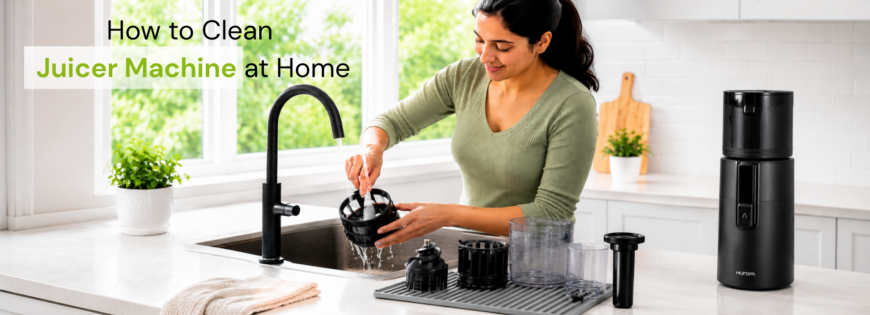
Step 3 – Rinse All Parts Under Running Water
Run each part under cool or lukewarm running water- not hot water, which can warp certain food-grade plastic components. For most parts, running water alone removes the majority of pulp and juice residue within seconds.
Step 4 – Use the Cleaning Brush on the Strainer
The fine mesh strainer is the component that requires the most attention. Use the cleaning brush that came with your machine – it is specifically designed for the mesh. Brush gently in circular motions under running water. Do not use abrasive scrubbers or harsh detergents that can damage the mesh over time.
Step 5 – Mild Soap for the Juicing Bowl and Hopper
Apply a small amount of mild dish soap to the juicing bowl and hopper. Wash, rinse thoroughly, and ensure no soap residue remains, soap taste in the next morning’s juice is not how anyone wants to start the day.
Step 6 – Air Dry Before Reassembling
Place all parts on a clean drying rack and allow to air dry completely before reassembling or storing. Assembling wet parts creates an environment where bacteria and mould can develop over time particularly in India’s humid climate.
Step 7 – Wipe the Motor Body
The motor base should never be submerged in water or placed under a tap. Wipe it down with a slightly damp cloth after every use to remove any drips or splashes from the counter area.
Total time for this process – 3 to 5 minutes when done immediately. That is genuinely all it takes.
Common Juicer Cleaning Mistakes Indian Users Make
Understanding what not to do is equally important for maintaining a juicer machine properly over years of daily use.
- Leaving pulp to dry – as discussed, this is the most costly mistake. Dried pulp in a mesh strainer can be extremely difficult to remove and may permanently stain the strainer over time
- Using hot water on food-grade plastic parts – high temperatures can cause warping and degradation of BPA-free plastic components. Always use cool or lukewarm water
- Using abrasive scrubbers – steel wool or rough scrubbing pads will damage the fine mesh strainer and scratch food-grade surfaces, creating grooves where bacteria can accumulate
- Submerging the motor body – the motor base contains electrical components and must never be immersed in water under any circumstances
- Using strong chemical detergents – harsh chemicals can leave residue on food-contact surfaces and degrade materials over time. Mild dish soap is sufficient for daily cleaning
- Skipping the reverse cycle before disassembly – most slow juicers have a reverse function. Running reverse for 3 to 5 seconds before switching off dislodges trapped produce from the auger and makes post-juice cleaning significantly easier
- Dishwasher use without checking the manual – some juicer parts are dishwasher safe, others are not. Check the manual for your specific model before placing parts in a dishwasher
How the Design of Your Juicer Determines Cleaning Time
Not all juicer machines are equally easy to clean and this is not about technique. It is about design.
Traditional slow juicers use a fine mesh strainer to separate juice from pulp. That mesh has hundreds of tiny holes, and pulp embeds itself in every one. Even with immediate rinsing and a brush, cleaning the mesh thoroughly takes 5 to 7 minutes on its own.
This is where the Hurom H400 Slow Juicer represents a genuine engineering difference. The H400 uses a strainer-free dual-auger design – the traditional fine mesh strainer is completely eliminated. Two augers work in coordination to juice and filter simultaneously, without any mesh component for pulp to embed in.
The practical result is remarkable. Without a mesh strainer, the most time-consuming part of slow juicer cleaning simply does not exist. Most H400 parts rinse clean under running water in under 2 minutes. There is no strainer to scrub, no mesh holes to clear, and no mineral buildup over time because there is no mesh surface for minerals to accumulate on.
This strainer-free design is one of the primary reasons the H400 has earned the Forbes Vetted Best Juicer 2024, the Kitchen Innovation Diamond Award 2023, and the Red Dot Design Award 2021 – recognition that evaluates real-world usability, not just specifications.
Hurom H400 Easy Clean Slow Juicer – Cleaning in Under 2 Minutes
The Hurom H400 Slow Juicer was specifically engineered around the cleaning challenge that causes most Indian users to abandon their juicer habit. Here is exactly what makes it different:
- Strainer-free dual-auger system eliminates the hardest component to clean in any slow juicer
- Fewer detachable parts simplified structure means less to disassemble, less to wash, and less to reassemble
- Quick-rinse design- all components are designed for maximum pulp release under running water with minimal scrubbing
- No mineral buildup without a mesh strainer, there is no surface for minerals from hard Indian water to accumulate over time
- Nesting pulp container keeps the workspace clean during juicing and makes post-juice pulp disposal simple and mess-free
- BPA-free food-grade components- all materials are safe for daily use and respond well to mild soap without degradation
The H400’s cleaning system represents what the easy clean juicer standard should actually look like in 2026 – not a feature addition, but a fundamental redesign of the components that make cleaning difficult in the first place.
Weekly Deep Cleaning For Every Juicer Machine
Daily rinsing keeps a juicer hygienic for regular use. But once a week, a slightly more thorough cleaning helps maintain peak performance and longevity:
- Soak the strainer (if your machine has one) in a solution of warm water and white vinegar for 10 to 15 minutes – this dissolves mineral deposits and loosens any embedded pulp residue
- Use a cleaning brush (comes with the juicer) for any hard-to-reach crevices in the juicing bowl or hopper connections
- Check the auger shaft for any pulp that may have accumulated around the base
- Wipe the motor body thoroughly with a damp cloth, paying attention to the ventilation slots
- Allow all parts to dry completely in open air before reassembling for the next use
This weekly routine adds 10 minutes once a week and significantly extends the life and hygiene of any juicer machine.
Cleaning Tips for Specific Indian Ingredients
Some ingredients commonly used in Indian kitchens require specific attention during cleaning:
- Beetroot – leaves a deep purple-red stain on components if left to dry. Rinse immediately and thoroughly. Soaking in diluted white vinegar removes stubborn beetroot staining from plastic components
- Turmeric – highly staining due to curcumin. Rinse immediately. A paste of baking soda and water applied to stained areas and left for 5 minutes before rinsing removes most turmeric staining effectively
- Amla – the tannins in amla can leave a slight brown tint on components over time. Regular rinsing prevents buildup
- Leafy greens – spinach, methi, and wheatgrass fibres can wrap around the auger shaft. Check the base of the auger during cleaning and remove any wrapped fibres with the cleaning brush
The Habit That Makes Everything Easier
Cleaning a juicer machine does not have to be a task you dread. It only becomes one when it is delayed, rushed, or approached without a simple system.
The Indian kitchen is already one of the most active and demanding spaces in any home. Morning routines are tight. Schedules are full. The last thing anyone needs is a machine that adds to that pressure rather than supporting the health goal it was bought for.
Build one habit – rinse immediately after every use. Everything else follows naturally from that. The cleaning stays quick. The machine stays hygienic. The parts last longer. And most importantly, the juicing habit actually sticks.
A good juicer machine earns its place on the counter not just by what it produces but by how little friction it creates in the daily routine. The best machines are the ones that get used every single morning, year after year, without a second thought about the effort involved.
That is the standard worth holding any juicer to. And that is the standard a well-maintained machine – cleaned right, every day will consistently meet.